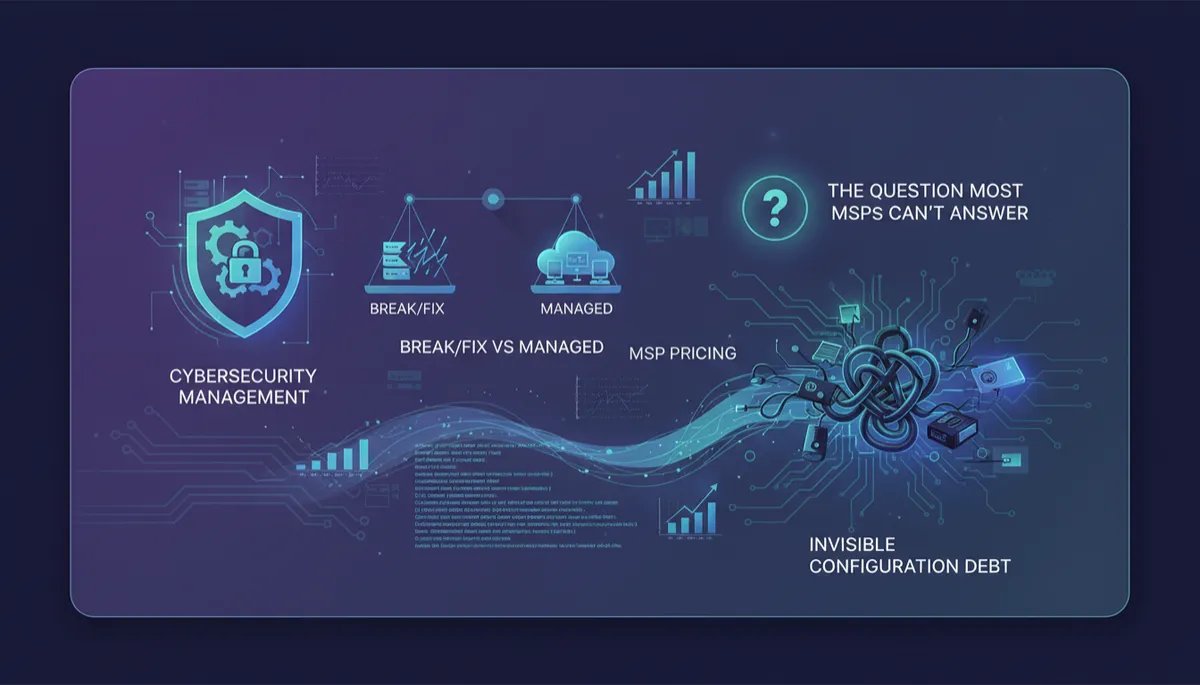
What Is Managed IT Services? Costs, Benefits & Red Flags
HOME I BACK TO BLOGS I ABOUT US I CONTACT US
Managed IT Services, MSP Pricing, Cybersecurity Management
What Is Managed IT Services? What You Pay For, What You Should Get, and the Question Most MSPs Can’t Answer
If you run a small or mid-sized firm, chances are you’ve been pitched “Managed IT Services” more times than you can count. Fixed fees, unlimited support, cybersecurity bundles, cloud, AI—every MSP claims to “take IT off your plate.” Yet cyber insurers, auditors, and big clients keep sending security questionnaires that your current provider struggles to answer.
What Managed IT Services Really Are (and Why the Definition Matters)
At its core, Managed IT Services means you pay a predictable monthly fee for an outside firm to run parts of your IT environment: help desk, servers, Microsoft 365, networks, backups, and often Cybersecurity Management. In 2026, most MSPs wrap this into per-user bundles—industry benchmarks put fully managed services around $145 per user per month in North America, with co-managed support closer to $85 per user (BestITMSPs pricing benchmark, 2026).
The problem is that “managed” is often used as a marketing word, not an operational promise. Many contracts describe an IT Support Model that is reactive—fixing issues when you call—rather than a disciplined system for enforcing security baselines, documenting risk, and proving to insurers or clients that controls actually stay on. That gap is where businesses lose coverage, fail audits, or discover after an incident that backups were never tested.
Support vs. Control: The Difference That Protects Your Business
Most MSPs sell support. What you actually need is control.
Support means answering tickets, resetting passwords, and fixing printers when they break. It’s the “call us when it hurts” side of IT.
Control means having documented standards, automated policies, and continuous checks that keep systems, identities, and data within those standards—day after day.
Cyber insurers, regulators, and large clients don’t ask, “Do you have someone to call when the server is down?” They ask, “Is multi-factor authentication enforced? Are backups tested? Is legacy authentication disabled? Can you prove it?” That’s control—and it’s where Delvetek Consulting focuses, using frameworks like NIST CSF 2.0 and CCCS to align IT operations with insurability and contract readiness, not just uptime.
Break/Fix vs. Managed: Why the Old Model Is So Risky Now
If you still pay an IT person or company by the hour when something breaks, you’re on a classic Break/Fix Vs Managed path. Break/fix might feel cheaper, but it creates perverse incentives: your provider is most profitable when you have problems. There’s little motivation to harden systems, automate patching, or close lingering security gaps that don’t cause immediate pain—but absolutely matter to attackers and insurers.
Modern IT Support Models should shift that risk. With a true managed agreement, your MSP’s margins depend on stability, automation, and security. They win when you have fewer incidents, not more. That only works, however, if the contract includes clear security baselines and regular verification—not just “unlimited remote support.”
MSP Pricing: What You’re Really Paying For
In 2026, the most common MSP Pricing structures are:
Per-user bundles – Typically $75–$200 per user per month, depending on whether support is co-managed or fully managed, and how much security is included.
Per-device – Often used in device-heavy environments; $40–$150 per device per month for endpoints, servers, and network gear.
Tiered bundles – Basic/Standard/Premium packages between $90 and $250 per user, with varying levels of security and response times.
The key is not just the number. It’s what’s actually enforced for that fee. Many “security add-ons” are sold as checkboxes—MFA, endpoint detection, backup, awareness training—without confirming that policies are configured correctly, applied to every user, and monitored continuously. Delvetek calls the result Invisible Configuration Debt: unenforced MFA, leftover admin accounts, legacy protocols, untested restores, and half-deployed tools hiding inside systems you already pay for.

Written findings turn vague promises into accountable, testable security controls.
Red Flags When Choosing an MSP
If you’re evaluating providers, watch for these warning signs:
“Free assessment” that ends in a sales pitch – but no written, prioritized risk report you can keep and compare.
Jargon instead of clarity – complex acronyms, no plain-English explanation of what’s on, what’s off, and why it matters to your insurance or contracts.
“Unlimited support” but vague security scope – no explicit baseline for patching, MFA, backup testing, or incident response.
Long-term lock-in contracts – especially when paired with poor reporting and no quarterly review against frameworks like NIST or CIS.
💡 Pro Tip: Ask to see a redacted sample of another client’s quarterly security report. If they can’t show one, they likely don’t operate with real control.
The Critical Question Most MSPs Can’t Answer in Writing
When Delvetek Consulting is brought in after a bad incident—or ahead of a tough cyber insurance renewal—we ask the incumbent provider a simple question:
“Can you show, in writing, exactly which security settings you enforce across our environment, how you verify they stay enforced, and how often you test them?”
Most MSPs cannot answer that question with a clear, dated document. They might reply, “We turn on MFA” or “We patch automatically,” but they can’t produce evidence that:
Every user and admin account is covered by those policies.
Exceptions are documented and approved by the business.
Controls are tested on a schedule, with results logged and followed up.
That gap between “we think it’s on” and “we can prove it’s enforced” is where Invisible Configuration Debt lives—and where insurers and attackers look first. Delvetek’s Insurability & Contract-Readiness Assessment is designed specifically to surface that debt, map it to NIST, CIS, and CCCS controls, and give you a prioritized, plain-English remediation plan.
Turning Managed IT into Insurable, Contract-Ready IT
Managed IT Services should give you more than a help desk number and a monthly invoice. They should give you confidence that if an insurer, regulator, or key client asks hard questions, you can answer with evidence—not hope. That means:
Clear separation of support (tickets, incidents) and control (policy, enforcement, verification).
Pricing that reflects not just tools, but the work of closing configuration gaps and keeping them closed.
Written, repeatable reporting that aligns to recognized security frameworks and insurance requirements.
If you’re an owner, executive, or accidental IT coordinator who’s tired of vague promises and nervous every time a new questionnaire lands in your inbox, it may be time to rethink what “managed” should mean for your business. Delvetek Consulting was built around one outcome: making your environment insurable and contract-ready by finding and fixing the Invisible Configuration Debt inside the tools you already own—and proving, quarter after quarter, that those fixes stay in place.
Next step: Book the Insurability & Contract-Readiness Assessment. You’ll receive a structured review of your environment against CCCS, CIS, NIST, and current cyber insurance requirements, plus a written, prioritized risk report that shows exactly where you’d fail today—and what to fix first.
HOME I BACK TO BLOGS I ABOUT US I CONTACT US
