NIST CSF 2.0 for Small Business: 6 Functions Explained
HOME I BACK TO BLOGS I ABOUT US I CONTACT US
Cybersecurity, NIST Cybersecurity Framework, Small Business Security, Cyber Risk Management
NIST CSF 2.0 for Small Business: The Six Functions in Plain English, and Where SMBs Actually Fail
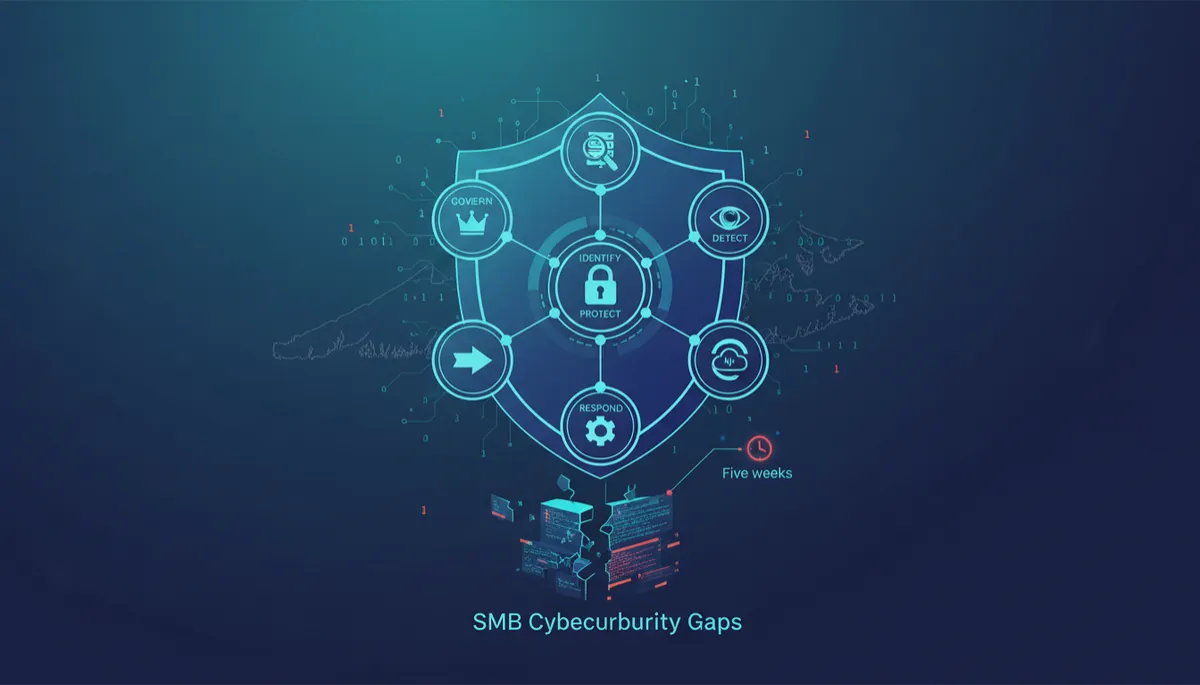
Five weeks. That’s how long attackers sat inside Nova Scotia Power’s systems in 2025 before anyone noticed. By then, data on hundreds of thousands of customers had been stolen and leaked online. For a small or mid-sized business, that kind of gap can be fatal. The NIST Cybersecurity Framework (NIST CSF 2.0) exists to close exactly those gaps — but most smaller organizations have never been shown how to use it in plain English.
What the NIST Cybersecurity Framework Actually Is
The NIST Cybersecurity Framework is a voluntary guide from the U.S. National Institute of Standards and Technology. It is not a product list and it is not a certification. Nobody hands you a “NIST compliant” badge. Instead, it describes the outcomes a well-run security program should achieve, organized into six Functions, 22 categories, and 106 subcategories in version NIST CSF 2.0, released in 2024 and expanded with new quick-start guides through 2026 (NIST SP 1299, SP 1308, SP 1347).
It’s written for organizations of any size and sector — including small firms in legal, healthcare, accounting, financial services, manufacturing, and professional services. At Delvetek Consulting, we benchmark Canadian and U.S. SMBs against NIST CSF 2.0, CIS Controls, and the Canadian Centre for Cyber Security’s Baseline Controls together, so your Small Business Security posture lines up with what insurers and clients expect in 2026.
The Six Functions in Plain English
1. Govern: Leadership Sets the Rules
New in NIST CSF 2.0, Govern is about who owns cyber risk. Who decides how much risk the business accepts? Who is accountable when something goes wrong? Which policies apply to staff and suppliers? In a small business, that’s usually the owner, CEO, or managing partner — not “whoever looks after IT.” This is where Cyber Risk Management becomes a business decision, not just a technical one.
2. Identify: Know What You Have
Identify is inventory and criticality. Which laptops, servers, cloud services, and line-of-business apps do you actually use? Which hold sensitive client or patient data? Which systems could you not operate without for even a day? For many SMBs, this is the first time anyone writes down a current asset list — including personal devices used for work.
3. Protect: Reduce the Odds and the Damage
Protect is what most people think of as Cybersecurity Best Practices: unique accounts with limited permissions, multi-factor authentication (MFA), security awareness training, hardened devices, encryption, and up-to-date software. Crucially for small businesses, it also includes backups: taken regularly, with at least one offline or immutable copy, and restores that are actually tested.
4. Detect: Notice When Something Is Wrong
Detect is about shortening that Nova Scotia Power–style delay. It means continuous monitoring of key systems and networks, collecting logs from multiple sources, and having alerts when something abnormal happens — failed logins, impossible travel, strange data transfers. Even basic log monitoring is a huge step up for SMB Cybersecurity Gaps.
5. Respond: Act on It
Respond is the plan you hope you never need. Who does what in the first hour? Who talks to your insurer, law firm, regulator, or major clients? How do you contain the incident so it stops spreading? NIST CSF 2.0 and its ransomware profile (NIST IR 8374) lay out practical steps; your business needs a version written in your own names, systems, and phone numbers.
6. Recover: Get Back to Work
Recover is where resilience shows. Restoring systems in priority order, verifying backups are clean before bringing them back, communicating honestly with clients, and building the lessons into your next round of improvements. This is also where insurers, regulators, and large customers judge how mature your Small Business Security really is.

A simple, written profile of your security posture beats ad‑hoc answers under pressure.
Where SMBs Actually Fail: Invisible Configuration Debt
Most small businesses don’t fail NIST CSF 2.0 because they lack tools. They fail because the tools they already pay for were never configured or verified properly. At Delvetek, we call this Invisible Configuration Debt: the unenforced MFA, legacy authentication still turned on, and backup jobs nobody has ever tried to restore.
Protect: MFA “available” but not required on every account. Legacy authentication protocols still enabled. Admin sprawl in Microsoft 365 — we routinely find 15–30 Global Admins in organizations with under 50 staff. NIST asks for least privilege; this is the opposite.
Protect & Recover: Backups that exist on paper but have never been test-restored. NIST is clear: untested backups are a theoretical asset, not a control.
Identify: No current inventory, ex‑employees with active accounts, and unmanaged personal devices accessing company data with no controls.
Govern: Nobody formally owns security, policies are missing or outdated, and suppliers who touch your data have no security requirements in their contracts.
Detect & Respond: Logs exist, but nobody reviews them. The “incident response plan” is either nonexistent or has never been rehearsed.
This debt is invisible during day‑to‑day operations. It appears during an insurance renewal, a major client’s security questionnaire, or a breach.
Why Insurers and Client Contracts Care
Cyber insurers and enterprise clients rarely ask, “Do you follow the NIST Cybersecurity Framework?” They ask about specific controls: Do you enforce MFA on all remote access? Do you use endpoint protection? How often do you test backup restores? Do you have an incident response plan and vendor management process?
The framework is how you organize those controls into something you can demonstrate. Walking into an insurance renewal or contract review with a simple, written picture of where you stand in each of the six Functions is far stronger than improvising answers the night before a deadline. It turns SMB Cybersecurity Gaps into a prioritized action list instead of a vague sense of risk.
How to Start with NIST CSF 2.0 as a Small Business
Pick a scope. Start where your risk lives: Microsoft 365, key cloud apps, and the laptops and phones that connect to them. You don’t need to boil the ocean on day one.
Describe where you are today. NIST calls this a Current Profile. In each of the six Functions, write down what you actually do today — not what you believe is happening.
Decide where you need to be. This is your Target Profile, shaped by insurer questionnaires, client contracts, regulatory obligations, and your own risk tolerance.
Close the gaps in priority order. Tackle the highest‑impact, lowest‑effort items first — often MFA enforcement, admin role cleanup, and backup testing — then schedule regular rechecks so gaps don’t quietly reopen.
💡 Pro Tip: NIST’s Quick Start Guides for smaller organizations show what good outcomes look like without forcing you to read every page of every standard.
How Delvetek Consulting Uses the Framework
Delvetek Consulting’s Insurability & Contract-Readiness Protocol is built around NIST CSF 2.0, CIS Controls, and the CCCS Baseline Controls, plus current cyber insurance requirements. We don’t sell vague “best practice” bundles. We benchmark your real environment against these frameworks and document exactly where your Small Business Security would fail an insurer or a client questionnaire.
After the initial remediation, we run quarterly reviews: tracking your Microsoft Secure Score, testing backup restores, auditing admin roles, and confirming that MFA, logging, and other key controls stay enforced. The goal is simple: find and fix Invisible Configuration Debt before an attacker, insurer, or major client finds it for you.
Find Out Where You Stand Today
You don’t need to memorize NIST CSF 2.0. You do need to know which of its gaps are yours. Delvetek Consulting’s Insurability & Contract-Readiness Assessment gives you a written, plain‑English, prioritized report showing exactly where you’d fail an insurer or client security review — and what to fix first to close your most important SMB Cybersecurity Gaps.
Book the assessment, get the facts in writing, and turn cybersecurity from a source of anxiety into a manageable business problem you can explain to your board, your insurer, and your biggest clients.
HOME I BACK TO BLOGS I ABOUT US I CONTACT US
